Monument sign cost for a commercial property typically falls between $5,000 and $20,000 nationally, according to HomeAdvisor, and the final number depends on face size, materials, lighting, foundation work, and the permits your site requires. Custom masonry and large illuminated builds can run well above that range, which is why a site-specific quote matters more than any average.
Signmakers has designed, fabricated, and installed custom signs since 1993. A monument sign pulls structural fabrication, illumination, finishing, and permit coordination into one project, so each of those areas shows up in the budget.
What Is the Monument Sign Cost for a Commercial Property?
A commercial monument sign typically costs $5,000 to $20,000, based on HomeAdvisor’s national figures, with the final price set by sign size, materials, lighting, foundation depth, electrical distance, and permit scope. Custom stone or brick builds, large illuminated faces, and tight sites sit at the upper end or above it.
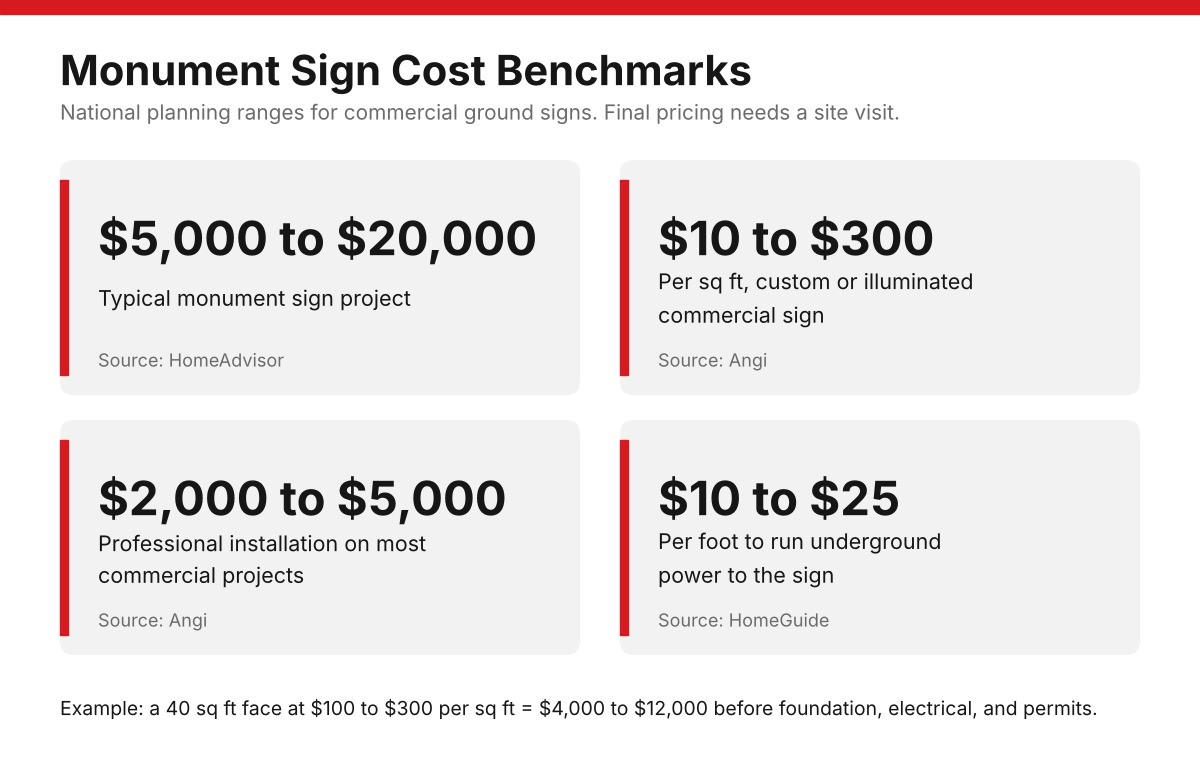
Two other benchmarks help when comparing bids. Angi reports $10 to $300 per square foot for custom or illuminated commercial signs, and notes that monument faces commonly measure 20 to 80 square feet. Per-square-foot math covers the sign itself, not the concrete footing, trenching, or permit work underneath it.
Monument Sign Cost Benchmarks From National Sources
| Budget Item | Typical Range | Source |
|---|---|---|
| Typical monument sign project | $5,000 to $20,000 | HomeAdvisor |
| Custom or illuminated commercial sign, per square foot | $10 to $300 | Angi |
| Typical monument sign face area | 20 to 80 square feet | Angi |
| Professional installation on most commercial projects | $2,000 to $5,000 | Angi |
| Professional sign designer | $50 to $150 per hour | Angi |
| Running underground power to the sign | $10 to $25 per foot | HomeGuide |
For scale, a 40-square-foot face at $100 to $300 per square foot lands between $4,000 and $12,000 before foundation, electrical trenching, and permit fees. A 40-foot underground power run adds roughly $400 to $1,000 at the quoted rate. These are national planning ranges, not Signmakers pricing, and every ground sign needs a site visit because soil, utilities, and the distance to power change the scope.
What Drives Monument Sign Pricing?
Five variables explain nearly every gap between a modest ground sign and a landmark one: face size, structure, electrical service, site conditions, and approvals.
Sign Face Size and Street Frontage
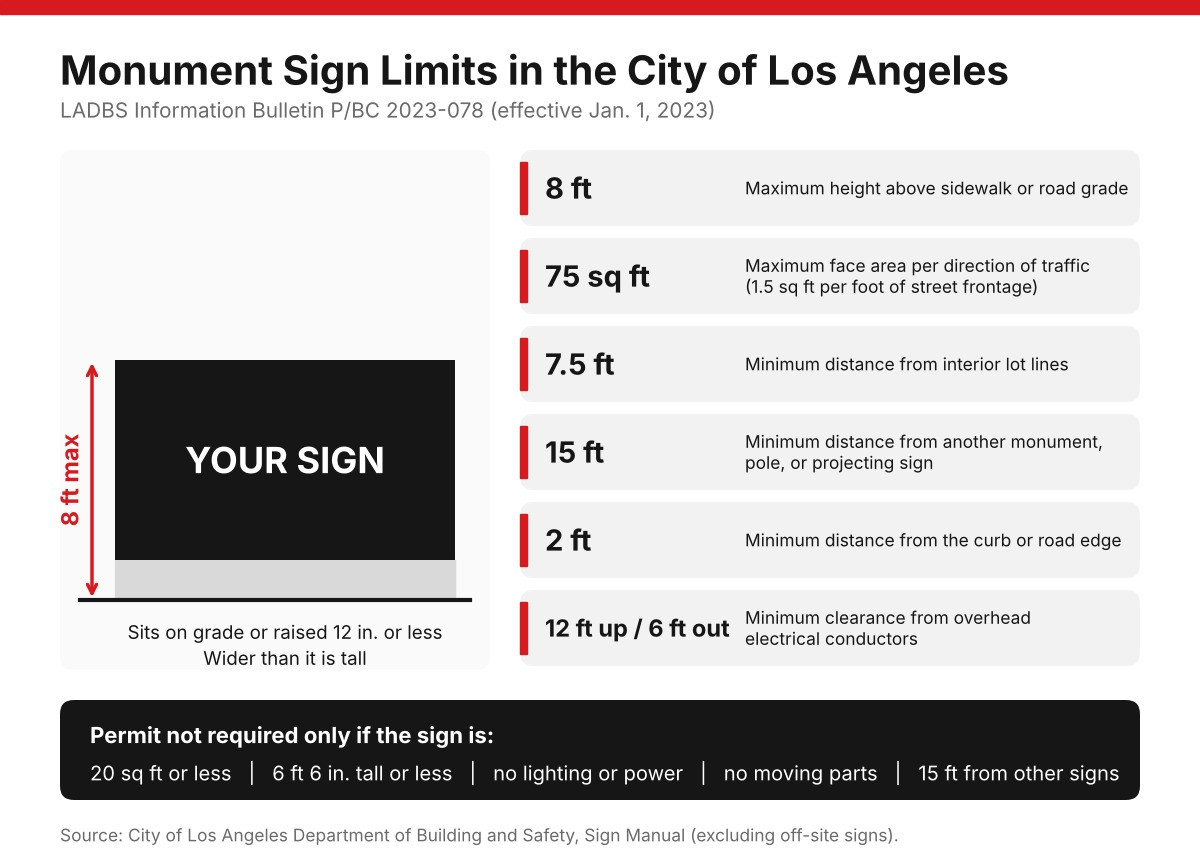
Size is the first cost lever, and in the City of Los Angeles it is also regulated. A monument sign face is capped at 1.5 square feet per foot of street frontage, up to 75 square feet for the face visible to the same direction of traffic. A property with 40 feet of frontage can carry up to 60 square feet, and 50 feet or more reaches the 75-square-foot ceiling. Height tops out at 8 feet above sidewalk or roadway grade.
Foundation and Structural Engineering
The cost that is hardest to see is underground. LADBS requires structural plans and calculations stamped by a licensed engineer or architect, including foundation and connection details for a freestanding sign. Excavation depth, soil bearing capacity, reinforced footings, and wind and seismic loads all feed that engineering. Footing and stamp costs do not shrink in proportion to a smaller sign face.
Electrical Service and Trenching
Distance to the nearest electrical panel and the surface that has to be cut to reach it both matter. Trenching through an existing parking lot or landscaped median costs more than a short run across open soil, and HomeGuide puts underground power at $10 to $25 per foot. Permits for illuminated signs in Los Angeles are issued only to a licensed C10 electrical contractor or C45 electrical sign contractor.
Site Conditions and Required Clearances
Surprises during excavation cost more than surprises during design. Gas, water, telecom, and irrigation lines need to be mapped against the sign footprint before fabrication starts. LADBS also bars signs within 2 feet of the curb or roadway edge, inside a visibility triangle, or within 6 feet horizontally and 12 feet vertically of overhead electrical conductors.
Permits, Inspections, and Approvals
Every new, altered, or removed sign in the City of Los Angeles needs a permit unless it falls into a narrow exemption covered below. Permit fees and review timelines change with project scope and department workload, so those figures should be confirmed with the department for your parcel.
Monument Sign Materials Compared: Masonry, Foam, and Metal
Material choice sets the structure, the foundation, the install method, and the look of the finished sign. The table compares the three most common builds, and any of them can carry stone, wood, or exposed-metal accents to echo the building facade.
| Material | Weight and Foundation | Look | Best Fit | Relative Cost |
|---|---|---|---|---|
| Stucco over CMU block or natural stone veneer | Heaviest. Deeper footings and a fuller engineering review | Permanent, traditional, high visual mass | Corporate campuses, medical and civic sites | Higher |
| Stucco-finished armored foam or HDU core | Light. Simpler footing and faster handling on site | Reads like masonry, with carved or layered detail | Sites with soil or weight limits, tighter timelines | Moderate |
| Aluminum or steel cabinet | Light to medium. Standard engineered footing | Clean and modern, built for LED backlighting | Multi-tenant centers with replaceable tenant panels | Lower to moderate |
Metal cabinet monuments are a natural fit for multi-tenant properties because a tenant panel can be swapped without touching the main structure. Cabinet framing and panels come from Signmakers’ aluminum and steel fabrication.
Pylon Sign vs Monument Sign: Which Fits Your Property?
A monument sign sits at or near grade and a pylon rises on poles, and the City of Los Angeles regulates them as two distinct sign types. LADBS defines a monument sign as one built on grade or raised no more than 12 inches, with a horizontal dimension equal to or greater than its vertical dimension. A pole sign, the code term for a pylon, is raised more than 12 inches on one or two poles.
| Feature | Monument Sign | Pylon (Pole) Sign |
|---|---|---|
| Mounting | On grade or raised 12 inches or less | Raised more than 12 inches on one or two poles |
| Maximum height | 8 feet | 25 feet (50 feet of frontage), 35 feet (50 to 100 feet), 42 feet (over 100 feet) |
| Maximum area | 75 square feet per face | 400 square feet for any one sign |
| Street frontage required | No minimum stated | At least 50 feet |
| Spacing from another monument, pole, or projecting sign | 15 feet | 15 feet |
Monument signs win where a property wants to look established and architectural at driver and pedestrian eye level. Pylons win where long sightlines over traffic or buildings matter more than appearance. Taller structures also need deeper footings and heavier engineering, so a pylon rarely costs less than a monument of the same face area. Property owners comparing both can review the full range of outdoor storefront and property signage before committing to a structure type.
Monument Sign Lighting Options and Operating Costs
Lighting changes both the look of the sign after dark and the electrical permit scope. Four approaches cover most projects:
- Internal LED illumination: LED modules inside a cabinet or channel face give even output, low power draw, and long service life. internally lit sign cabinets and electrical work is the standard choice for multi-tenant and face-lit signs.
- Halo-lit dimensional letters: light washes the wall or panel behind the letters for a softer, premium glow. raised dimensional lettering also adds depth in daylight.
- External floodlighting: ground-mounted fixtures aim at masonry or stone faces where internal lighting is impractical. They add fixture maintenance.
- No lighting: an unlit sign of 20 square feet or less and no taller than 6 feet 6 inches can avoid permitting altogether in the City of Los Angeles.
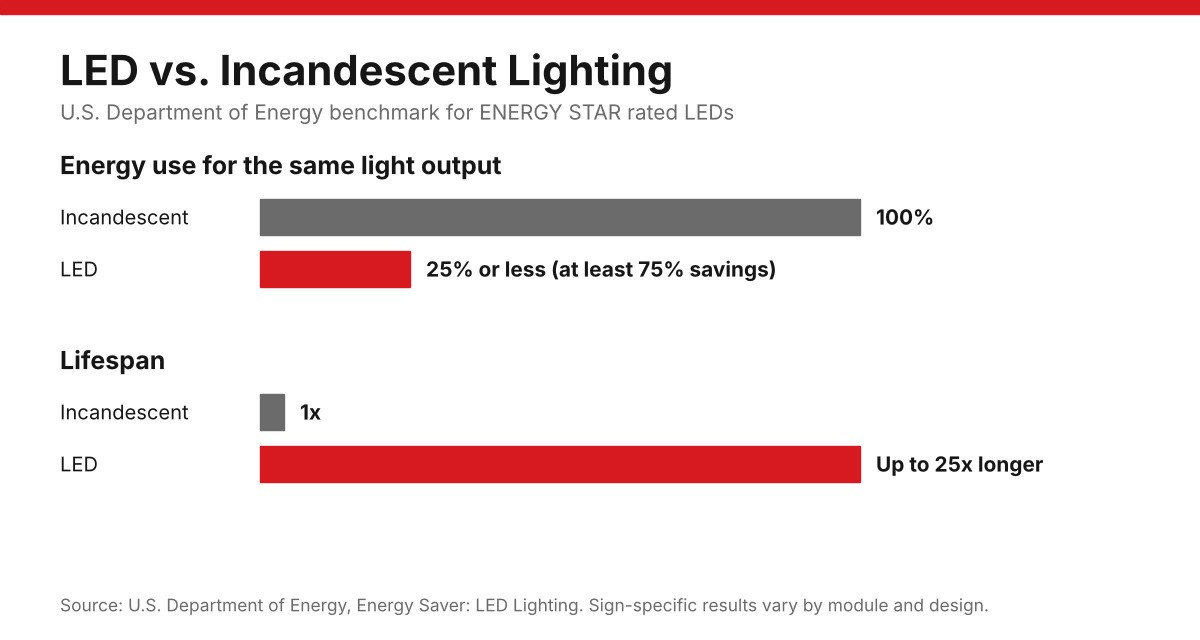
The U.S. Department of Energy reports that ENERGY STAR rated LEDs use at least 75% less energy and last up to 25 times longer than incandescent lighting, which is why LED has replaced older sources in nearly all new sign work. Some zones add limits. The HI zone prohibits illuminated monument signs and digital displays, and an on-site digital display in any zone needs a recorded owner affidavit with LADBS.
Monument Sign Design: Layouts That Read From the Street
Good monument sign design starts with who has to read it and how fast they are moving. A driver gets a few seconds, so the sign carries the name, a short descriptor, and an address, not a paragraph.
| Design Type | Best For | Design Priority |
|---|---|---|
| Single-tenant monument | Offices, clinics, restaurants, retail pads | One bold name and logo with strong contrast |
| Multi-tenant monument | Plazas, shopping centers, business parks | Replaceable tenant panels and a clear hierarchy |
| Entrance or campus monument | Schools, residential communities, corporate campuses | Architectural match with stone, stucco, or metal |
| Illuminated monument | Properties busy after dark | Even lighting with no glare or hot spots |
- Contrast first: light letters on dark panels, or the reverse, read faster than mid-tone pairings.
- Limit the copy: name, logo, and one descriptor beat a list of services.
- Match the building: repeat facade materials and colors so the sign looks planned with the property.
- Add the address: visitors and responders both look for it, and street address numerals built to match the sign.
- Plan for change: tenant panels and replaceable faces keep the structure useful for decades.
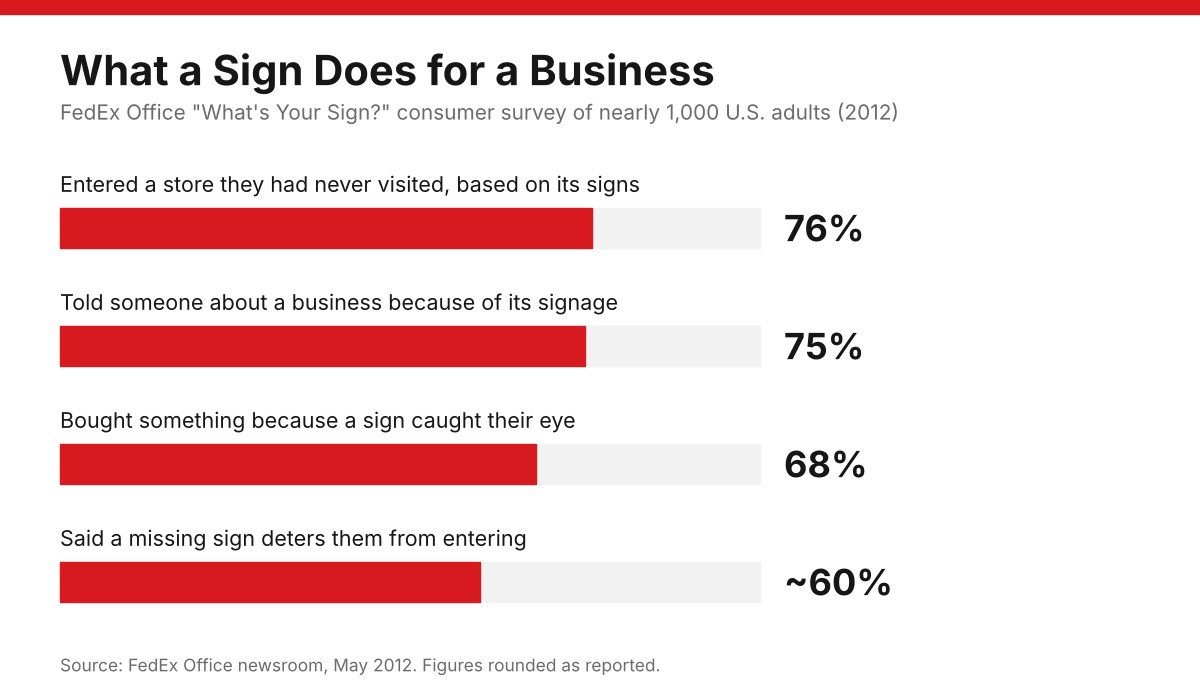
The business case is well documented. A FedEx Office survey found that 76% of consumers had entered a store they had never visited based on its signs, and 68% had bought something because a sign caught their eye. Nearly 60% said a missing sign would deter them from entering. For architects and design teams specifying signage, early coordination keeps structure, lighting, and code limits aligned from the first sketch.
Monument Sign Permit Rules in the City of Los Angeles
New, altered, and removed signs in the City of Los Angeles need an LADBS permit. The main exemption is a ground sign of 20 square feet or less, no taller than 6 feet 6 inches, with no lighting, power, or moving parts, placed at least 15 feet from other signs.
Monument Sign Permit Steps
- Confirm zoning. The zone decides which sign types are allowed, and specific plans or planning entitlements can add limits.
- Prepare the plans. A plot plan shows lot dimensions, buildings, and the size, location, and type of each proposed and existing sign, with elevations showing height and size.
- Obtain a sign pre-inspection. LADBS requires a sign pre-inspection with an 8.5 by 11 inch plan for each new sign.
- Add stamped structural plans. A licensed engineer or architect documents materials, foundation, and connection details.
- Pass plan check and receive the permit. Review happens at an LADBS permitting office.
- Pull the electrical permit. An illuminated sign needs a licensed C10 electrical contractor or C45 electrical sign contractor.
Where Monument Signs Are Restricted
- C1, C1.5, and CR zones: monument signs are not permitted, and signs attach to the building instead.
- HI zone: illuminated monument signs and digital displays are prohibited.
- Mini-shopping centers and commercial corner developments: monument signs belong only in landscape-planted areas.
- Near freeways: signs within 500 feet of a freeway need Department of Transportation approval, and signs viewed primarily from a freeway within 2,000 feet are not permitted.
Face Changes vs New Monument Structures
Swapping copy on an existing permitted sign is far simpler than building new. LADBS does not require a permit for a non-structural face change, but removing the cabinet triggers a permit and full compliance with current code. Alterations follow a sliding scale tied to replacement cost:
- 10% or less of replacement cost in a year: repairs may match the existing construction if area, height, location, and orientation stay the same.
- 10% to 50%: allowed with no increase in area or height and no change in location or orientation, with new work built to current code.
- Over 50%, or any increase in area or height: the sign must fully comply with current code.
Other cities set their own height, area, and setback limits, so a sign designed for one jurisdiction should not be copied to another without a code check.
How to Get an Accurate Monument Sign Quote
A complete monument sign quote itemizes design, engineering, fabrication, foundation, electrical, permit coordination, and installation, so bids can be compared line by line. Having these details ready speeds the process:
- Property address and linear feet of street frontage
- Photos of the intended location, including nearby driveways and landscaping
- Permit details for any existing monument sign
- Number of tenants and how often panels will change
- Lighting preference and distance to the nearest electrical panel
- Logo files, brand colors, and the building materials the sign should match
Signmakers works with business owners planning a new property sign from the first concept through final installation. The shop sits at 3652 Main St, open Monday through Friday, 7 AM to 4 PM. Call (323) 930-1300 or contact the Signmakers team to schedule a site and design consultation.
Kris Herbert, owner of The Gym Venice, described the process after working with the shop on his storefront signage:
“I went to them with an idea and they worked with me through a number of designs until it was perfect and better than I envisioned. My signage is the first thing seen when your walking, biking, or driving by and it attracts and lures you in with a curious excitement.”
Kris Herbert, owner of The Gym Venice
Monument Sign Cost and Design FAQs
How much does a monument sign cost?
Most commercial monument signs cost between $5,000 and $20,000, according to HomeAdvisor’s national figures. Custom masonry, large illuminated faces, long electrical runs, and engineered foundations push the total higher. A site visit is the only way to price a specific property accurately.
How big can a monument sign be in the City of Los Angeles?
A monument sign can stand up to 8 feet tall above sidewalk or roadway grade. The face is capped at 1.5 square feet per foot of street frontage, up to 75 square feet for the face visible to the same direction of traffic. Zoning, specific plans, and overlays can add stricter limits.
Do I need a permit to replace the face of a monument sign?
A non-structural copy or face change does not require an LADBS permit. If the sign cabinet is removed, a permit is required and the sign must comply with current codes.
What is the difference between a monument sign and a pylon sign?
A monument sign sits on the ground or within 12 inches of it and is wider than it is tall. A pylon, which LADBS calls a pole sign, is raised more than 12 inches on one or two poles and can stand 25 to 42 feet tall depending on street frontage.
Does a monument sign need structural engineering?
A permitted freestanding sign needs structural plans and calculations stamped by a licensed engineer or architect, including foundation and connection details. The only permit-free ground signs are small ones: 20 square feet or less, no taller than 6 feet 6 inches, and without lighting or power.
What is the best material for a monument sign?
It depends on the site. Stucco over CMU block or natural stone veneer offers the most mass and a permanent look. Stucco-finished foam or HDU delivers a similar appearance at lower weight. Aluminum or steel cabinets suit multi-tenant signs with replaceable panels.
How should a monument sign be lit?
Internal LED illumination, halo-lit dimensional letters, and external floodlights are the common options. In Los Angeles, permits for illuminated signs go only to a licensed C10 electrical contractor or C45 electrical sign contractor, and some zones restrict illuminated monument signs.
Can a monument sign include a digital display?
Sometimes. LADBS requires a recorded owner affidavit for on-site digital signs, and some zones, such as the HI zone, prohibit digital displays outright. Zoning has to be confirmed before design starts.
What information do I need for an accurate monument sign quote?
Send the property address, street frontage, photos of the intended location, existing sign permit details, the number of tenants, your lighting preference, and brand artwork. A site visit then confirms soil conditions, utilities, and the distance to electrical service.