Your business sign cost depends on far more than the size of the sign. Materials, lighting, structure, permits, and installation each shape the final number, and the right answer for a restaurant on a busy boulevard looks very different from the right answer for a professional office lobby. Searching for a single price usually turns up vague national averages and online vendors who ship something that a city inspector may flag before it ever goes up.
This guide explains the real factors behind custom business sign pricing in Los Angeles so you can budget with confidence and compare quotes fairly.
What Determines Your Business Sign Cost in Southern California?
When people ask how much a sign costs, they are usually hoping for one number. There is no simple flat rate. Custom signage is built to order, and every project is priced around dimensions, materials, mounting surface, lighting, and local zoning requirements. A fabricator who quotes before understanding those details is guessing, and guesses tend to turn into change orders later.
It also helps to think of an exterior sign as a long-term physical asset. A well-built channel letter installation can last a decade or more with modest upkeep, so the cheapest option on day one is often the most expensive over time once replacements, repairs, and compliance corrections are counted.
Why Custom Pricing Beats Template Pricing
Stock signs from online vendors rarely account for the building they will hang on or the rules they must satisfy. A sign that is the wrong scale for the facade, or that cannot meet structural or lighting requirements, does not save money if it has to be redone. Custom work starts with the block, the viewing distance, and the brand, then prices the sign that actually fits.
How Climate and Location Shape the Budget
Southern California is demanding on outdoor signs. Sustained UV exposure and daily heat cycles degrade some plastics and adhesives faster than spec sheets suggest, and coastal installations face salt air that accelerates corrosion on standard metals. Choosing corrosion-resistant materials is not an upsell. It is the difference between a sign that holds up for years and one that looks neglected within a couple of seasons. Owners comparing fabricated metal signage can weigh these durability factors against the budget up front.
Breaking Down Cost by Sign Type and Material
How Materials Shift the Budget
Material selection is where most pricing variation lives. Solid aluminum or stainless steel letters carry a different cost profile than routed acrylic, and illuminated options add power supplies, wiring, and electrical work. Finish matters too. Brushed, painted, and anodized surfaces all require different processes, and each affects both appearance and longevity.
- Aluminum: light, corrosion resistant, and well suited to cabinets, channel letters, and panels.
- Stainless steel: premium durability for coastal exposure and high-end lettering.
- High-density urethane (HDU): carved and dimensional lettering that holds paint and resists moisture.
- Acrylic: clean light diffusion and crisp edges for illuminated faces.
Business Sign Cost by Sign Type
The table below shows the main drivers behind the most common commercial sign formats. Because pricing varies so much by project, it focuses on what moves the cost rather than inventing numbers.
| Sign Type | What It Is | Main Cost Drivers |
|---|---|---|
| Channel letters | Individual three-dimensional letters mounted to a facade or raceway | Illumination type (front-lit, halo-lit, or both), letter depth, and mounting hardware for the wall |
| Monument signs | Ground-level structures near street or parking entries | Structure, footings, engineering, and any integrated display |
| Dimensional metal and acrylic | Non-illuminated letters and logos for lobbies and exteriors | Material thickness, surface finish, and mounting method |
| Hand-bent glass tubing | Classic glowing signs, including complex multi-color pieces | Tubing length, colors, transformers, and secure mounting |
| Banners and portable signs | Temporary signage for openings and promotions | Vinyl weight, size, finishing, and wind exposure |
Channel letters are among the most popular formats for storefronts, and our illuminated sign options show how lighting choices change both the look and the scope of the work.
For the warm glow that reads beautifully at dusk, real glass tubing remains hard to beat, and our hand-bent glass tubing work covers both single-color signs and large multi-color installations. Modern LED neon alternatives have closed much of the visual gap and can lower ongoing energy use, so the right choice depends on the look you want.
Businesses that need temporary signage for a grand opening or seasonal promotion can start with portable sign formats, which are typically the most accessible entry point.
| Get a Custom Sign Quote |
Permitting, Engineering, and Costs Beyond Fabrication
Permit Costs and Timelines
In Los Angeles you cannot simply hang a sign and open the doors. The Los Angeles Department of Building and Safety reviews commercial signs, and its online permit process includes plan review for projects that need it. Structural calculations, electrical permits, and plan check submissions are part of the process for most commercial installations, and each step has its own fees and timeline.
Because fee schedules and review times change with submission volume, we do not publish figures here. What stays constant is that skipping permits is never a real shortcut. Unpermitted signs can be ordered removed, and the cost of forced compliance almost always exceeds the cost of doing it correctly the first time.
Historic Overlay Zone Review
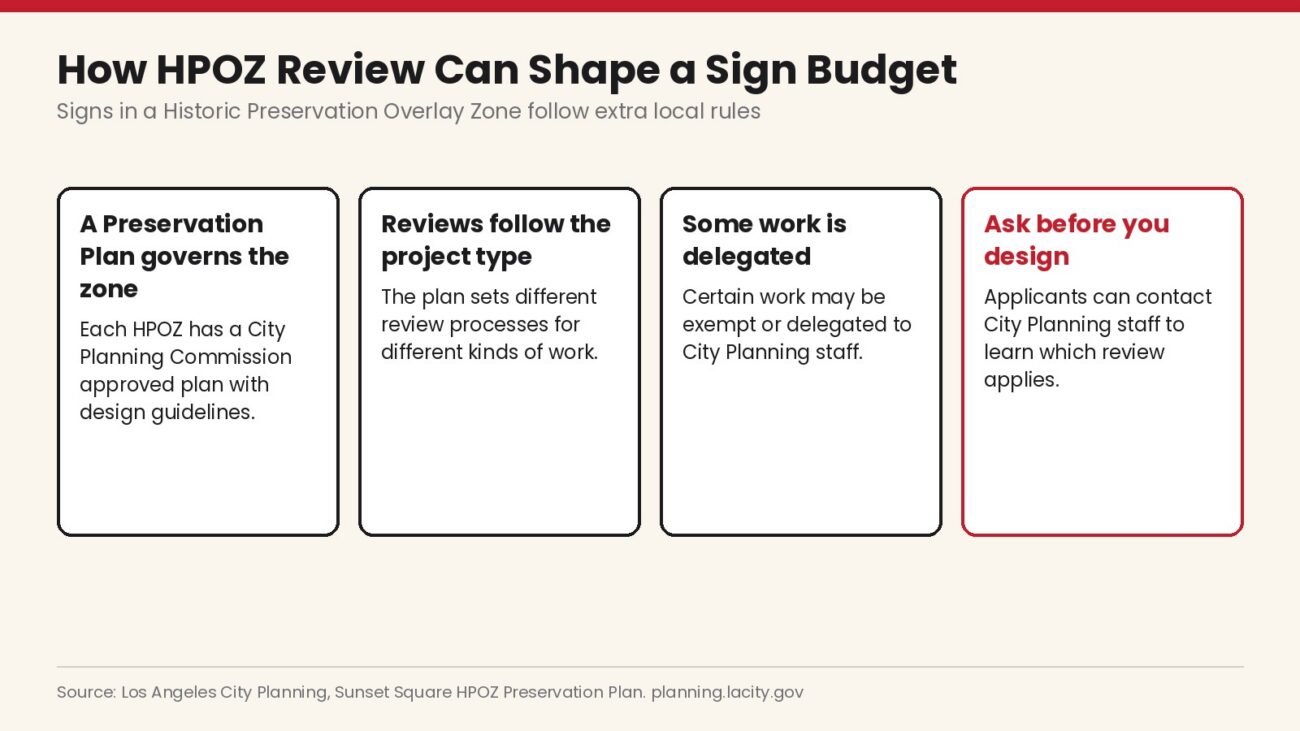
If your business sits inside a Historic Preservation Overlay Zone (HPOZ), expect another layer. Neighborhoods such as Carthay Circle and Whitley Heights each operate under a Preservation Plan with design guidelines, and a sign’s materials, mounting method, and lighting may be reviewed against them. Drawings, engineering, and review time should all be built into the budget.
Working with a fabricator who has handled submittals and overlay-zone reviews before means you are not learning the process on your own dime, and that local experience has real dollar value.
Installation and Structural Engineering
Fabrication is only half the project. Mounting a heavy sign on a facade, or setting a monument sign in a parking lot, requires engineering review, the right rigging, and a crew that understands what seismic activity demands of a wall anchor. Fasteners differ for concrete, steel stud, and masonry, and none of them are interchangeable.
Several variables push installation costs up or down:
- Building height, since a second-story install may need a boom lift while a taller facade can require crane coordination and traffic control.
- Electrical work, because illuminated signs need a dedicated circuit and connection by a licensed electrician.
- Site access, sign weight, and the condition of the mounting surface.
Our exterior sign solutions are planned with these installation realities in mind, which keeps surprises off the final invoice.
How Illuminated Signs Affect Operating Cost
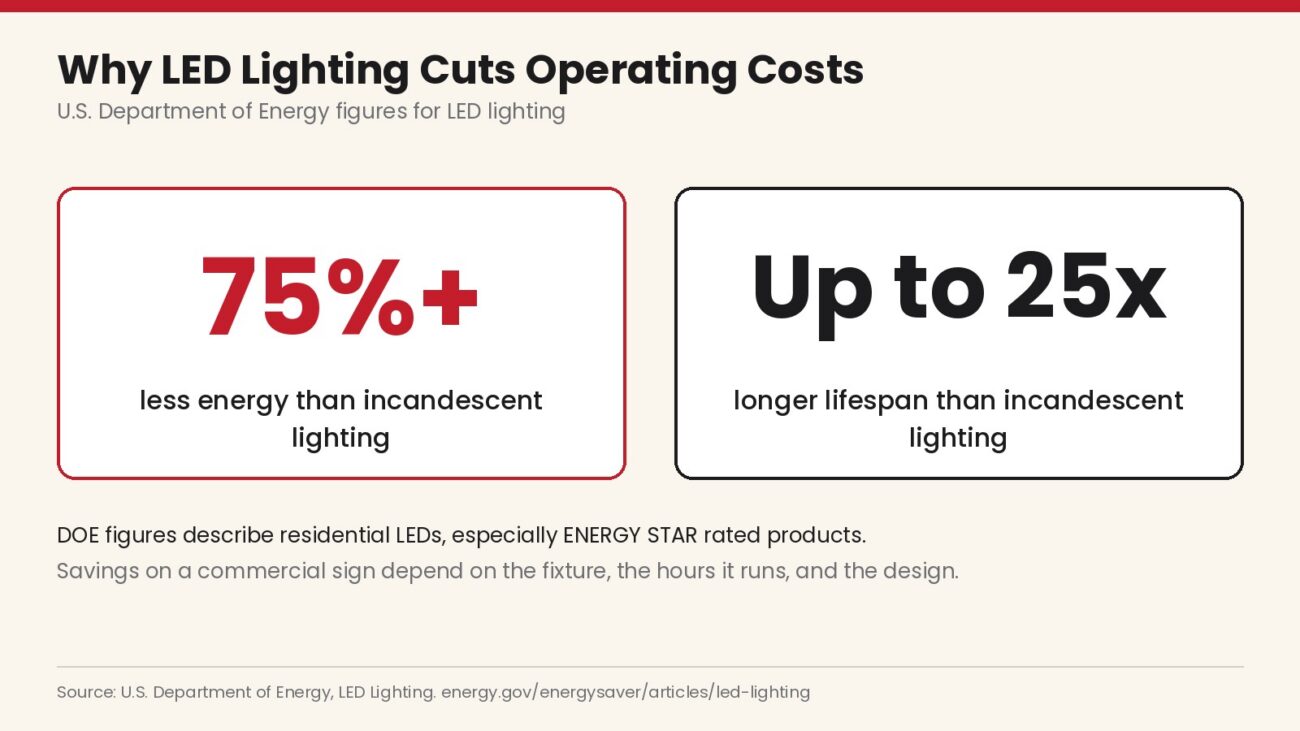
Purchase price is only part of the picture. A sign that runs every evening has an energy cost, and lighting technology changes it significantly. The U.S. Department of Energy reports that residential LED lighting uses at least 75 percent less energy and lasts up to 25 times longer than incandescent lighting, and the same efficiency logic is why LED has become the default for many illuminated signs.
California’s Energy Code also shapes the design. According to the California Energy Commission, the code includes control requirements for illuminated signs and lighting power requirements for internally and externally illuminated signs, and it covers both indoor and outdoor signs, including those lit with unfiltered LEDs or unfiltered neon.
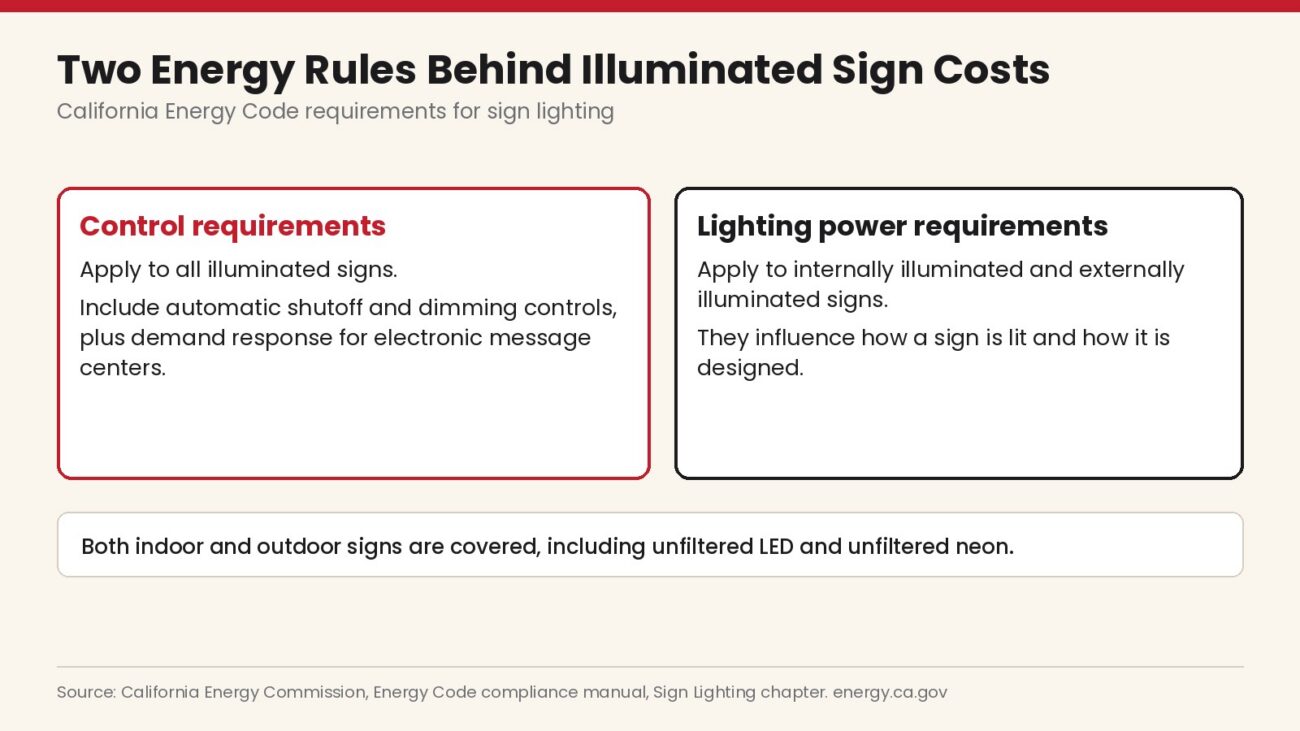
Building these controls into the design and the electrical permit submission from the start avoids costly redesigns after plan check.
Ways to Plan and Control Your Sign Budget
What a Good Quote Includes
A reliable estimate spells out the full scope, so you can compare proposals fairly. Ask every company to itemize:
- Design and artwork, including revisions.
- Engineering and permit preparation, and who handles each.
- Materials, finishes, and lighting type.
- Fabrication and installation, including lifts or rigging.
- Electrical connection, inspections, and any retrofits needed.
Smart Ways to Stretch Your Budget
Starting early gives you room to phase a project, choose materials with the best long-term value, and avoid rush charges. Retailers refreshing a storefront can explore retail storefront sign options that combine a permanent main sign with lower-cost supporting graphics. Sharing your budget range at the start also helps a fabricator recommend options that fit instead of designing something you cannot afford.
Business Sign Cost Questions Answered
What is the average cost of a business sign in Los Angeles?
There is no reliable average, because custom signs are priced to the specific project. Dimensions, materials, illumination, mounting complexity, and permit scope all change the number, and a simple flat panel and a large illuminated installation sit in completely different categories. Any firm figure offered before someone understands your building, your design, and your zoning is a guess. The most accurate way to learn your cost is a quote based on your actual project.
How long does it take to get a sign permit approved?
It depends on the sign type and the property. A straightforward wall sign usually moves faster than an illuminated installation that needs structural engineering review. If your location falls inside a Historic Preservation Overlay Zone (HPOZ), an additional review under the zone's Preservation Plan can lengthen the timeline. Starting the permit process early, ideally before fabrication begins, is the most reliable way to protect your opening date.
Can I install a business sign myself to save money?
For most commercial signs, it is a risky way to save. Heavy signs must be attached securely to the building, and illuminated signs need properly designed electrical connections, both of which are reviewed during permitting and inspection. A failed inspection can mean delays, removal, and paying for the work twice. Professional installation also brings the insurance, equipment, and engineering that protect you and your building.
What materials last longest for outdoor signs in Southern California?
Aluminum, stainless steel, and high-density urethane (HDU) are strong choices for exterior work. They resist the UV exposure that fades painted surfaces and the heat cycling that stresses lower-grade plastics. Coastal installations benefit from corrosion-resistant metals because salt air accelerates oxidation on standard alloys. HDU suits carved and dimensional signs because it paints well and does not absorb moisture the way wood does.
How do illuminated signs affect my ongoing operating costs?
LED lighting typically uses far less energy and lasts much longer than older lighting technologies, which lowers the cost of running a sign every evening over a multi-year period. The exact savings depend on the fixture, the hours of operation, and the design. California's Energy Code also requires controls on illuminated signs, so the design should include them from the start. Hand-bent glass remains the right choice when the look of real neon matters most.
Why do sign quotes vary so much between companies?
Quotes differ because the scope differs. One estimate may include design, engineering, permit preparation, fabrication, and installation, while another covers only the sign itself and leaves the rest as add-ons. Ask each company to itemize what is included, which materials and finishes are specified, and who handles permits and inspections. Comparing like for like is the only way to compare prices fairly.
Get a Quote Today
A custom business sign is one of the most durable brand decisions you will make, and it works every day by drawing attention, communicating credibility, and anchoring your brand on the street. Understanding the full scope of design, materials, fabrication, permitting, and installation is what keeps cutting corners from surfacing as a problem later, usually at a worse time and a higher cost.
If you are planning a new storefront or refreshing an existing one, talk with our team or call (323) 930-1300 to schedule a consultation, and see how our completed sign projects compare with what you have in mind.
| Request Your Quote |
You can also explore everything we build at Signmakers’ custom sign services.